Individual Critical Analysis – Ahmet Tunahan Sasmaz
Individual Critical Analysis – Ahmet Tunahan Sasmaz
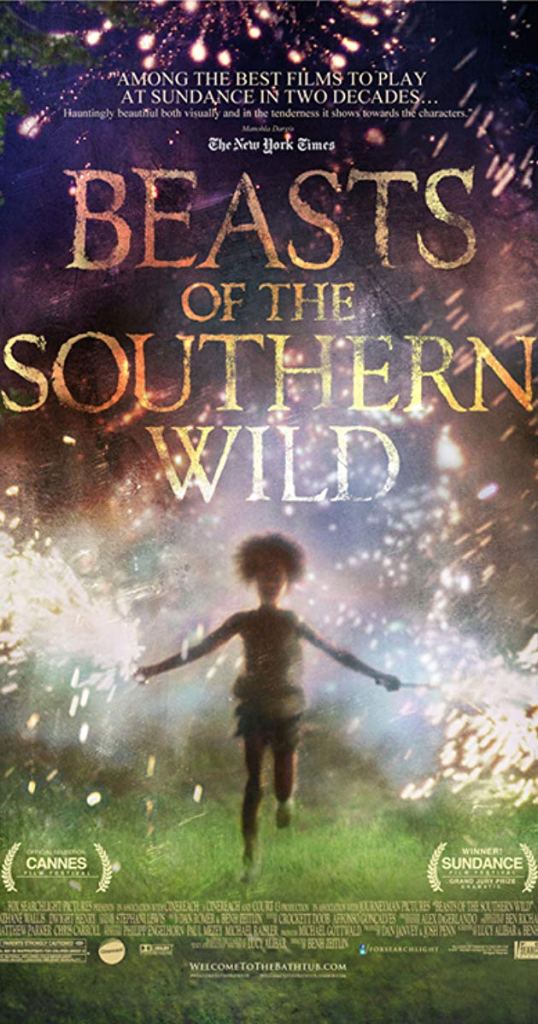
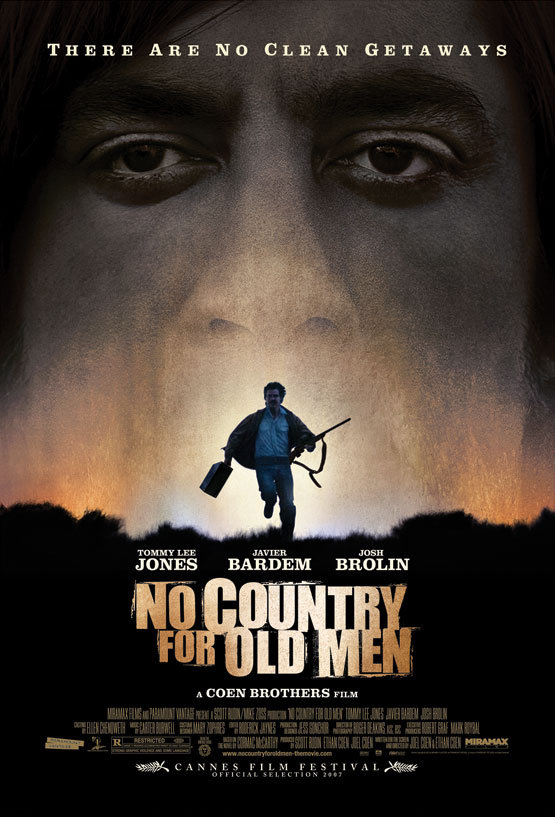
My chosen films are Beast of the Southern Wild (Zeitlin, US, 2012) and No Country for Old Men (Coen Brothers, US, 2007).
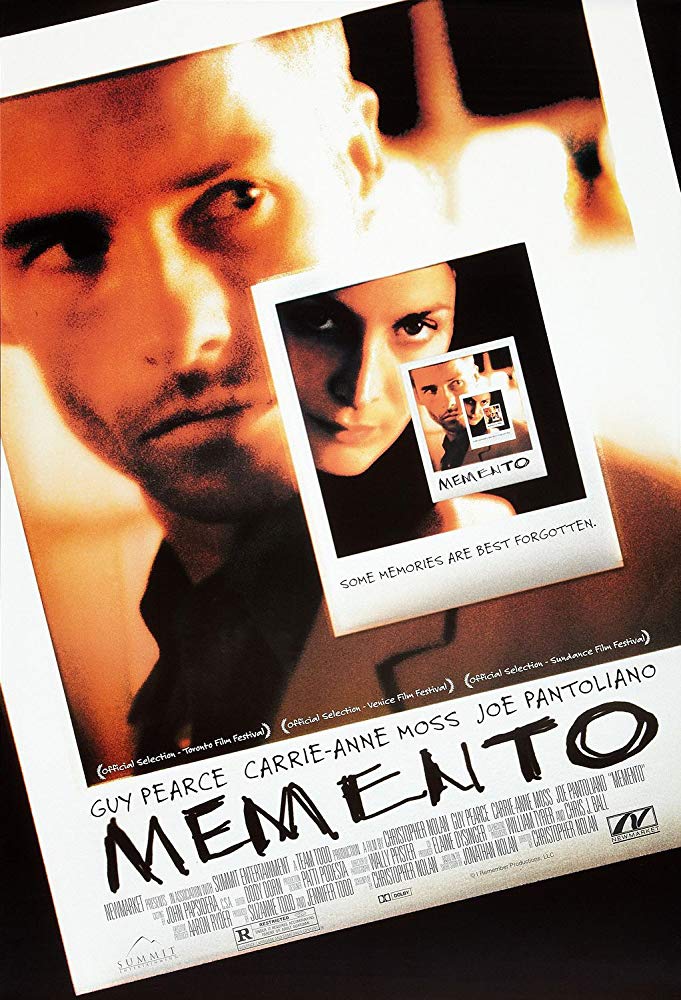
“it would seem that the majority of both Hollywood and international films follow a narrative structure that is largely traditional and tends towards the chronological. However, the relative popularity of such modular narratives as Pulp Fiction and Memento (Christopher Nolan, US, 2000) suggests that audiences are now acclimatized to achronological narrative structures.” Cameron, A., 2008. Modular narratives in contemporary cinema. In Modular Narratives in Contemporary Cinema (pp. 1-19). Palgrave Macmillan, London. Firstly, I would like to point out the industrial context and its clear impact on narrative structures to films on a wide scale. From the quotation above, it is evident that films with disruptive and non-linear narratives were greatly encouraged by the economic success of trendsetters of non-linear narratives like: Pulp Fiction (Quentin Tarantino, US, 1994) and Memento (Christopher Nolan, US, 2000). Rather than traditional methods of setting the scene, telling backstories and flashbacks, what Pulp Fiction and Memento popularised are totally out of place scenes which disrupt continuity of narrative. This technique in which Tarantino utilises in his later movies goes hand in hand with the editing style of his movies which some may say further disrupts spectators from fully emerging in his films; numbered scenes and post production shapes establishes that the spectator doesn’t have a visceral experience but rather, these techniques allow the auteur to let the audience know that they are watching a film.

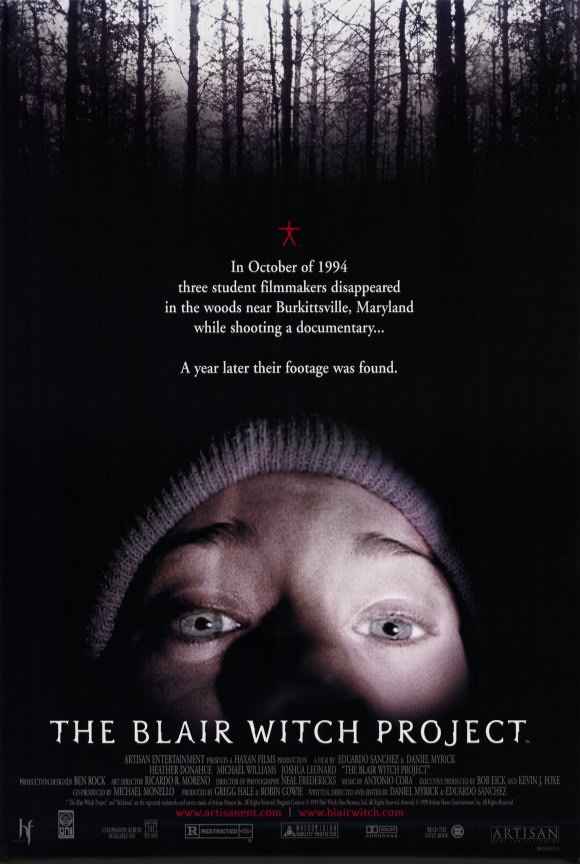
“The Blair Witch Project’s wildly successful distribution is well known. The filmmakers created buzz through an innovative marketing campaign that included a Sci Fi Channel mockumentary that promoted the film and a number of web sites designed to create the 9 4 R E I N V E N T I N G C I N E M A illusion that the murders depicted in the film were real. From this innovative web campaign, the film grossed over $140 million in U.S. box office alone” Tryon, C., 2009. Reinventing Cinema: Movies in the Age of Media Convergence. Technological contexts are key factors that shape narrative and its storytelling. Following the success story of The Blair Witch Project’s (Daniel Myrick & Eduardo Sánchez, 1999) (TBWP) distribution and national estimated gross it is clear that independent filmmaking wasn’t bound to Hollywood studios to make a profit. Technological advancements allowed for films such as TBWP to reach a global audience while also not breaking the bank with traditional marketing schemes blockbuster Hollywood films may resort to. With this global reach and cheap marketing it pushed filmmakers to not compromise on their storytelling to appeal to a mass audience in order to make profits but rather it enabled filmmakers to tell niche stories to still be able to audiences that would otherwise not have been reached with a tight budget.
Beasts of the Southern Wild (Zeitlin, US, 2012) centres on a young girl named Hushpuppy and her life in the Louisiana bayou before and after a catastrophic flood. Beasts combines the subgenre of magic realism with the emotive topic of the fate of the dispossessed poor after a natural disaster. Magic realism is a genre that incorporates magical or fantasy elements into a predominantly realist film; for instance, Beasts is a realist film in its portrayal of people living on the precipice of destruction after being neglected by society, but Zeitlin also manages to incorporate magical elements into Beasts such as the aurochs. “a certain poetic transfiguration of the object world itself – not so much a fantastic narrative, then, as a metamorphosis in perception and in things perceived” Jameson, F., 1986. On magic realism in film. Critical Inquiry, 12(2), pp.301-325. Beasts is also a typical independent film, as it challenges mainstream Hollywood conventions by foregrounding an exploration of character over a focus on action or entertainment. “characterised mainly by low-budget films that often represented an individual filmmaker’s artistic or political vision, the 1990s saw an increasing popularisation of independent cinema as a particular brand of ‘quality’ filmmaking.” King, G., 2005. American independent cinema (p. 119). London: IB Tauris.
Characters in independent cinema are less likely to be archetypes or stereotypes and more likely to be well-drawn, complex representations of individuals. “Lippmann’s notion of stereotypes as a short cut points to the manner which stereotypes are a very simple, striking, easily-grasped form of representation” Dyer, R., The Role of Stereotypes. The inhabitants of the bathtub are a close community and share ideologies, but they are diverse in terms of age and ethnicity. In traditional cinema, children and girls in particular, are typically represented as physically and emotionally vulnerable, however, in Beasts, Hushpuppy challenges many of these stereotypes, as she is relatively independent, has her own brand of wisdom and copes admirably in traumatic situations. “Wood identifies the gender “ideal” as well as the shadow of that ideal. The ideal male, as crafted and dictated by this ideological network, is a powerful, adventuresome type; alternately, the ideal female is a dependably submissive wife and mother. The “shadow” identities cast the male as the dull and settled husband/father while the female counterpart is fascinating, but dangerous, the prototypical femme fatale.” Bart, J.T., 2014. Once upon a time in Louisiana: the complex ideology of Beasts of the Southern Wild. Cinesthesia, 3(2), p.2. It has been argued that independent films are more challenging for audiences as they are more open to interpretation and invite a wider range of responses, this supports the notion of the active spectator; a spectator who might not necessarily read into the directors preferred reading of the film but take a negotiated or oppositional reading for themselves. “Sometimes when we watch a film we disappear into it, losing ourselves in the created world… We carry with us the values and experiences we have helped create during that viewing” Swenson, S., 2007. Active Spectatorship: Spiritual Dimensions of Film. BYU Studies Quarterly, 46(2), p.6. This argument however, may not be true for Beasts, as Zeitlin has chosen to shoot most of the film with an easy rig. This lends documentary style realism to a lot of the footage and also places the spectator in the action, creating immersion. This use of camera to echo Hushpuppy’s responses and the prevalence of shots either of her or from her perspective helps to keep her at the centre of the narrative and encourages spectators to align themselves with her pushing for a more passive response. “Being a spectator means being passive” Rancière, J., The Emancipated Spectator.
Most theories of the active spectator share the notion that the spectator plays a role in interpreting a film and that people will have diverse responses to any scene. A theory that challenges this, and places the spectator in a passive role, is the idea of emotional contagion. “the process of emotional contagion is much too automatic, fast and fleeting, and too ubiquitous to be accounted for by such cognitive, associative, or self-perception processes.” Doherty, R.W., 1997. The emotional contagion scale: A measure of individual differences. Journal of Nonverbal Behavior, 21(2), p.131. Plantinga argues that filmmakers try to exploit this tendency by constructing ‘scenes of empathy’ to encourage spectators to catch the emotion the onscreen character is feeling. A scene of empathy typically features shots of long duration, with shallow depth of field, which take the spectator increasingly close to the protagonist’s face. Zeitlin certainly utilises these techniques to make Wink’s death a scene of empathy. He employs long takes, shallow depths of field and a series of close ups of both characters. The use of Hushpuppy’s voice-over is also crucial in encouraging identification as we have privileged insight into her thoughts throughout the film.
No Country for Old Men (Coen Brothers, US, 2007) is an American neo-Western crime thriller film written and directed by Joel and Ethan Coen, based on Cormac McCarthy’s 2005 novel of the same name. The complexities of the film have made assignment from traditional genres difficult, often resulting in a hybrid of the Western/Thriller/Noir genres. “drawing on film noir techniques to defy what their Western materials seem to solicit.” Mitchell, L.C., 2014. Dismantling the Western: Film Noir’s Defiance of Genre in No Country for Old Men. Genre: Forms of Discourse and Culture, 47(3), pp.335-356. No Country transcends these hybridisations, however, demanding a unique genre: The Neo-Western. The traditional Western, one that operates within a direct morality, wherein hero and villain have well-defined roles and undertake specific tasks. No Country leaves these traditions of morality behind, focusing instead on the transformative nature of the American West and the new reality into which its characters are thrust. The emergence of an amoral villain in Anton Chigurh and an aging hero Sherriff Bell’s inability to comprehend his opponent are chief among the redefining characteristics of No Country for Old Men.
The filmmakers use aspects of narrative and film form to construct a story, which is often loaded with meanings they hope to communicate to the person watching. The spectator plays their role by bringing to this interaction their own ideologies formed by past experiences and their own perspectives shaped in part by demographic factors. Decisions about how to tell a story and how to construct narrative have a tremendous impact on audience response. Incorporating binary oppositions encourages spectators to take a side and feel invested. For example, a passive spectator may interpret Llewelyn as the hero of this story when compared to the antagonist Anton. Some reasons behind this may be the fact that during the hunting scene where we follow Llewelyn stumble upon a drug deal gone bad, we associate the cowboy hat and star studded boots with the typical image of a cowboy hero in traditional westerns; together with this, is the close up shots and shots from Llewelyn’s perspective make us feel close to the character. The preferred reading a passive spectator may interpret is that the Coen Brothers want us to align ourselves with Llewelyn. This binary opposition pitting the two protagonists against each other is helpful in creating expectations of what is to come for the characters and provides insight into whether Llewelyn will be able to escape with the cash or if Anton will get the better of him. On the other hand, an active spectator may take it upon themselves to figure out that in fact Llewelyn isn’t the typical hero we want to align ourselves with, from the implications of his dialogue with the Mexican man asking for water and the way he acts selfishly for his own benefit, all create a conflict with the ideals of a hero.
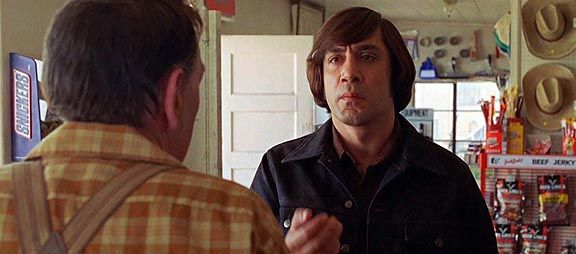
In the scenes leading up to the coin toss, Anton has already strangled a policeman with handcuffs and shot a man using an air-powered gun. He is unmoved by these deaths and seems to kill for the sake of killing. Thus, when we see Anton pull up to a gas station, the initial thoughts of the spectator is anticipation for trouble. Attendant: “I seen you was from Dallas.”, Anton: “What business is it of yours where I’m from, friendo?”, it is this exact interaction that sets a domino effect in the shots to come. The scene encourages a passive response, that response being: Anton seems taken back at the mention of his past and it is evident that the attendant is unaware of Anton’s murderous spree, but he quickly senses something is awry and tries to bring an end to the conversation. Through the close ups and reverse shot reverse sequence audiences are positioned to align themselves with the gas station attendant and the Coen Brothers preferred reading of this scene could be to interpret the uneasy feeling of the attendant via emotional contagion. The tension in this scene keeps rising as the characters go back and forth with each shot panning the camera slightly closer to the face of the characters, mirroring how audiences are being pushed closer and closer into this unnerving scene.
In conclusion, despite being outside the Hollywood filmmaking system, Beasts conforms to the Hollywood style of encouraging a dominant reading and treating the audience as a mass unit rather than as individual spectators that are capable of interpreting films in a diverse way. Comparatively, a majority of the scenes in No Country encourages an active response. This doesn’t necessarily mean the Coen Brothers don’t include a dominant reading, it means to reach these meanings audiences have to use their own perspectives more so to interpret the meanings. In one film (Beasts of the Southern Wild) we are encouraged to feel a certain type of way whereas in the other film (No Country for Old Men) we presented with complex characterisations of typically simplistic and traditional characters that we’re accustomed to from earlier films in the genre. This leads the spectator to create thoughts and judgement of the story and add meaning to the characters on screens’ actions through our own understanding of them. The difference being in BOTSW there is a clear plot arc and it flows; we start at point A (equilibrium) and end at point Z with a new equilibrium. Comparatively, NCFOM’s beginning and ending both have the same enigma as each other; where at the beginning of the film we’re thrust into action following Llewelyn Moss’ character and are intrigued by what is to come during the following minutes of the film, we end the film with even more questions some unanswered during the narrative and other questions that rose from the narrative choices of the directors itself, such as: why did a protagonist like Llewelyn die off screen?, was everything Anton had to endure worth it? And ultimately, what sense does the Sheriff’s dreams make in contribution to the narrative? To some audiences the narrative storytelling style of NCFOM may seem unfulfilling but at the same time it encourages a thought process and activates audiences to actively add meaning to the narrative while watching, with each audience member arriving at different meanings in their own minds.
Reference List:
- Cameron, A., 2008. Modular narratives in contemporary cinema. In Modular Narratives in Contemporary Cinema (pp. 1-19). Palgrave Macmillan, London
- Tryon, C., 2009. Reinventing Cinema: Movies in the Age of Media Convergence
- Jameson, F., 1986. On magic realism in film. Critical Inquiry, 12(2), pp.301-325.
- King, G., 2005. American independent cinema (p. 119). London: IB Tauris.
- Dyer, R., The Role of Stereotypes
- Bart, J.T., 2014. Once upon a time in Louisiana: the complex ideology of Beasts of the Southern Wild. Cinesthesia, 3(2), p.2
- Swenson, S., 2007. Active Spectatorship: Spiritual Dimensions of Film. BYU Studies Quarterly, 46(2), p.6.
- Rancière, J., The Emancipated Spectator.
- Doherty, R.W., 1997. The emotional contagion scale: A measure of individual differences. Journal of Nonverbal Behavior, 21(2), p.131.
- Mitchell, L.C., 2014. Dismantling the Western: Film Noir’s Defiance of Genre in No Country for Old Men. Genre: Forms of Discourse and Culture, 47(3), pp.335-356.
 Individual Critical Analysis

